平时做技术实践时,很多问题不是概念不会,而是细节没串起来。拿“powershell远程管理服务器磁盘空间的实现方法代码”来说,它看着像小点,放到项目里常会牵出环境、配置、兼容性和维护成本。下面按实际采用顺序,把思路、关键写法和容易踩坑的地方讲清楚,便于大家直接对照操作。
一、启用远程管理
1、将管理服务器的trusthost列表改为*
运行Set-item wsman:localhostclienttrustedhosts –value *
2、在远程服务器上运行Enable-PSremoting
注:
实际处理时,在本地服务器上以Administrator运行“Enable-Psremoting、 Winrm Quickconfig、 Set-WSManQuickConfig”,均提示“访问被拒绝”,可能的原因如下所示:
1.在工作组计算机上,确认组策略: secpol.msc > Local Policies > Security Options > Network Access: Sharing and security model for local accounts - change to classic
2.修改注册表:Set-ItemProperty –Path HKLM:SOFTWAREMicrosoftWindowsCurrentVersionPoliciesSystem –Name LocalAccountTokenFilterPolicy –Value 1 –Type DWord
3.确认WinRM服务是否正在运行,Windows Firewall服务是否正在运行,网络位置是否不是“公用”,如果要启用PS远程管理,此时网络位置不能被设置为public,因为Windows 防火墙例外不能在网络位置是public时被启用。
4.Telnet localhost 47001是否能够连通
5.运行 winrm get winrm/config 是否会提示“访问被拒绝”
6.Administrator密码不能为空
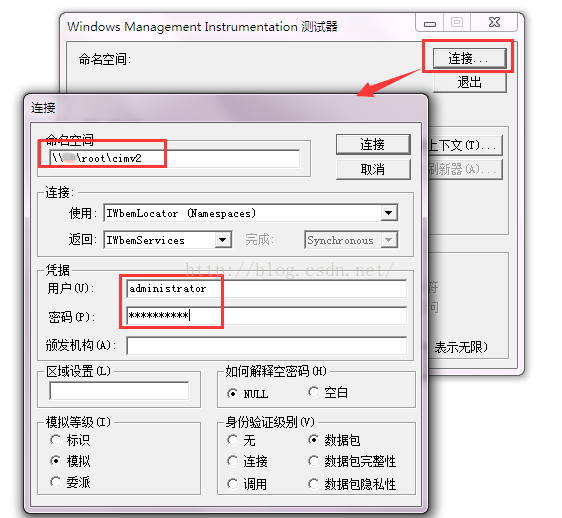
结合项目来看,远程启用开启之后能够在cmd命令窗口输入wbemtest测试是否能够连接远程服务器,如图:
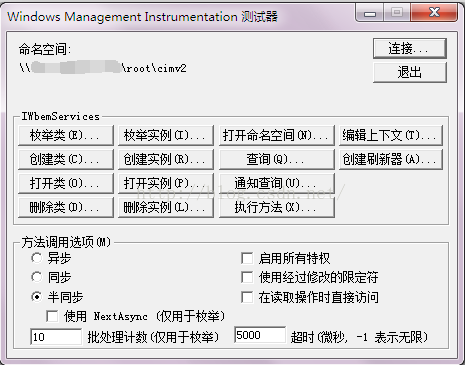
连接成功的状态如下所示所示:
下面就能够来取每个服务器的磁盘空间了
二、脚本
$server = "."
$uid = "sa"
$db="master"
$pwd="数据库sa密码"
$mailprfname = "test" ---需要跟select name FROM msdb.dbo .sysmail_profile一致
$recipients = "接收邮箱,多个用;隔开"
$subject = "邮件标题"
$computernamexml = "E:powershellcomputername.xml"
$alter_xml = "E:powershellcpdisk.xml"
$pwd_xml = "E:powershellpwd.xml"
function GetServerName($xmlpath)
{
  $xml = [xml] (Get-Content $xmlpath)
  $return = New-Object Collections.Generic.List[string]
  for($i = 0;$i -lt $xml.computernames.ChildNodes.Count;$i++)
  {
    if ( $xml.computernames.ChildNodes.Count -eq 1)
    {
      $cp = [string]$xml.computernames.computername
    }
    else
    {
      $cp = [string]$xml.computernames.computername[$i]
    }
    $return.Add($cp.Trim())
  }
  $return
}
function GetAlterCounter($xmlpath)
{
  $xml = [xml] (Get-Content $xmlpath)
  $return = New-Object Collections.Generic.List[string]
  $list = $xml.counters.Counter
  $list
}
function Getpwd($xmlpath)
{
  $xml = [xml] (Get-Content $xmlpath)
  $returnpwd = New-Object Collections.Generic.List[string]
  for($i = 0;$i -lt $xml.pwd.ChildNodes.Count;$i++)
  {
    if ( $xml.pwds.ChildNodes.Count -eq 1)
    {
      $pw = [string]$xml.pwd.password
    }
    else
    {
      $pw = [string]$xml.pwd.password[$i]
    }
    $returnpwd.Add($pw.Trim())
  }
  $returnpwd
}
function CreateAlter($message)
{
  $SqlConnection = New-Object System.Data.SqlClient.SqlConnection
  $CnnString ="Server = $server; Database = $db;User Id = $uid; Password = $pwd"
  $SqlConnection.ConnectionString = $CnnString
  $CC = $SqlConnection.CreateCommand();
  if (-not ($SqlConnection.State -like "Open")) { $SqlConnection.Open() }

  $cc.CommandText=
      " EXEC msdb..sp_send_dbmail
       @profile_name = '$mailprfname'
      ,@recipients = '$recipients'
      ,@body = '$message'
      ,@subject = '$subject'
      "
  $cc.ExecuteNonQuery()|out-null
  $SqlConnection.Close();
}
$names = GetServerName($computernamexml)
$pfcounters = GetAlterCounter($alter_xml)
$upwd = Getpwd($pwd_xml)
$report = ""
for($m=0;$m -lt $names.count;$m++)
{
$cp=$names[$m]
$p=New-Object -TypeName System.Collections.ArrayList
$uname="administrator"--因为取的服务器用户名都是administrator,如果每台机器不一样,可以放在XML等文件中读取
$pw=$upwd[$m]
$upassword=convertto-securestring $pw -AsplainText -force;
foreach ($pfc in $pfcounters)
{
  $filter="deviceID='"+$pfc.get_InnerText().Trim()+"'"
  #$Disk =get-wmiobject win32_logicaldisk -computername $cp -Filter $filter
  #$counter=$Disk.Freespace/1024MB
  $cred=new-object system.management.automation.PSCredential($uname,$upassword);
  $counter=(get-wmiobject -credential $cred -class win32_logicaldisk -computername $cp -filter $filter).Freespace/1024MB
  $total=(get-wmiobject -credential $cred -class win32_logicaldisk -computername $cp -filter $filter).Size/1024MB
  #$pfc = $pfcounters[$i]
  $path = "机器名:"+$cp+"; 盘符:"+$pfc.get_InnerText()
  $diskFree=";总磁盘空间大小为:"+[math]::truncate($total).ToString()+"G;当前剩余空间大小为:"+[math]::truncate($counter).ToString()+"G!"
  $item = "{0} {1} " -f $path,$diskFree
  $report += $item + "`n"
}

}
$report
if($report -ne "")
{
  CreateAlter $report
}
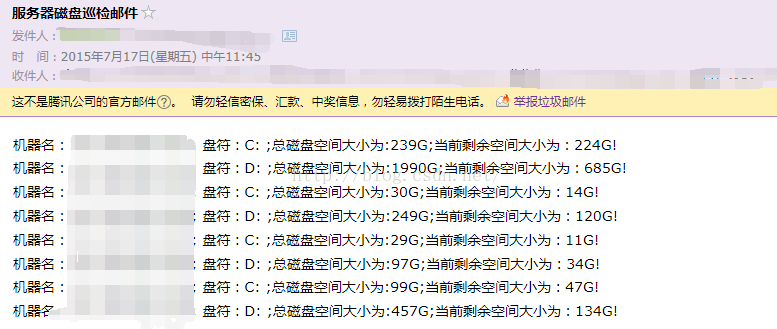
效果:
附:
xml文件格式:
1、computername.xml
<computername>
    <computername>
    test
    </computername>
</computernames>
2、cpdisk.xml
<Counters>
    <Counter>C:</Counter>
    <Counter>D:</Counter>
</Counters>
3、pwd.xml
<pwd>
    <password>
     helloworld
    </password>
<pwd>
完毕,欢迎拍砖!大笑
- Powershell目录文件夹管理权限的继承和指定方法
- Powershell比较两个文件夹的不同
- PowerShell遍历文件、文件夹的方法
- PowerShell中采用Test-Path命令检查文件或文件夹路径是否存在示例
- PowerShell统计文件夹下文件个数的方法
- Powershell中拿到所有磁盘盘符的方法
- Powershell中的文件夹共享及磁盘映射的操作步骤